
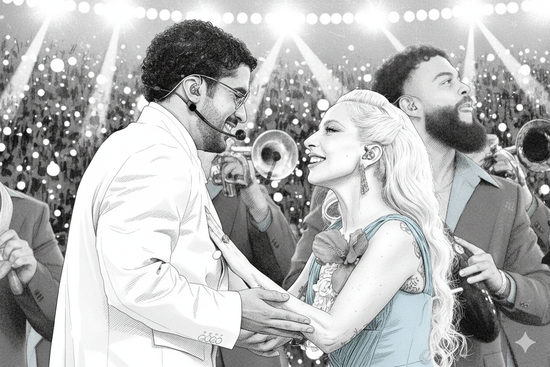
From Tokyo to the Super Bowl
Yesterday afternoon, from Tokyo, I watched the Super Bowl halftime show. I am not a follower of American football; my interest lies solely in the spectacle—the sheer scale of the production and what it represents for the artists who reach that stage to share their art. It is well known that being invited to this event confirms an artist is truly world-class, guaranteeing top-tier entertainment and record-breaking audience levels. For this 2026 edition, the protagonist was Bad Bunny, the Puerto Rican reggaetón singer.
The Roots of the Rhythm
Benito Martínez, the artist’s real name, began his career back in 2016. At the time, many Spanish speakers—myself included—didn’t quite connect with his songs due to his lyrics and style. However, Bad Bunny was not the pioneer; Daddy Yankee created the genre nearly two decades ago. Back then, I was living in Brooklyn, New York; my neighborhood was full of Puerto Rican and Central American neighbors, and it was there that I learned to appreciate reggaetón while stopping by the local corner deli. While that was happening in “Uncle Sam’s country,” the genre had yet to find popularity in South America; it was still stigmatized as marginal music from the ghettos.
A Bold Transformation
As the years passed, and despite the critics, reggaetón managed to consolidate its place, to the point where even icons like JLo and Shakira embraced the rhythm. Neither quietly nor discreetly, the “Bad Bunny” kept working, polishing his craft. He began to refine himself in every sense: from his image to his songwriting, turning his videos into genuine audiovisual masterpieces.
His detractors used to say he wouldn’t open his mouth to sing or that, like a typical Puerto Rican, he couldn’t pronounce his “Rs.” But the rhythm of his songs had already won us over. This had nothing to do with our academic level or language, but rather the vibe and the infectious “tropicality” that identifies all of us who grew up in the Americas: North, Central, and South.
Discovering Benito
In late 2025, while having breakfast with a colleague in the city, I mentioned that I had listened to Bad Bunny’s latest album on the recommendation of my music app. I was pleasantly surprised by the song “Debí tirar más fotos” (I Should Have Taken More Photos), in which he reflects on the passage of time and the importance of embracing the present before it inevitably becomes the past. That album felt different; I finally discovered a version of Benito that had previously been hidden behind the “Bad Bunny” brand. From that moment on, I became genuinely interested in his music, his journey, and his identity.