There is a rather pervasive notion in the world of home organization—the idea that if one simply learns the ‘right’ way to fold a garment, one’s life will suddenly fall into place.
Having lived in various corners of the world, and having spent time creating start-ups, the last one focused on home services here in Tokyo, I have come to see that this is only the surface of the matter. Minimalism is not really a destination, nor is organization a mere chore to be ticked off a list. Rather, it is a way to quietly reclaim a little autonomy in a world that often feels intent on filling our spaces—and our minds—with unnecessary noise.
My approach, which I call Bio-Spatial Synchrony™, is perhaps a bit more considered than the common trends one might see. It is about the quiet intersection between our internal state and the physical environment we inhabit. When we clear the clutter from our minds, we often find it easier to clear our homes, and vice versa. It is a gentle, continuous feedback loop.

The Foundation: Organizing with Intent
True home organization is not about keeping things tidy for an afternoon; it is about creating a system that serves you daily life with ease. Here are a few principles to help you move toward a more conscious way of living:
Mind Your Capacity

The goal is quite simple: to keep only the amount of items that your space can comfortably hold. When we overfill our homes, we lose the ability to move through them with any sense of ease. A comfortable home is one where every object has its place and can be retrieved without fuss. If your home feels a little tight, the solution is rarely to buy more storage bins; it is, perhaps, to take a moment to assess what truly belongs in your ecosystem.
The Courage to Let Go
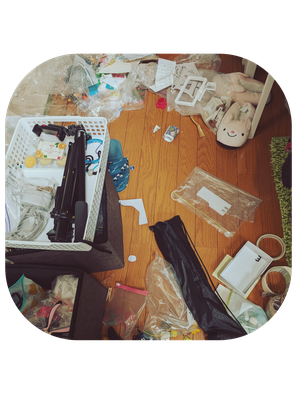
We often hold onto items out of a sense of obligation or a quiet, underlying anxiety. However, hoarding is rarely conducive to a peaceful life. It can be helpful to ask: Does this item serve who I am today, or is it merely a relic of who I used to be? If an item no longer adds value to your life or your well-being, finding the courage to let it go is a profound act. Keeping one's inventory to a functional minimum is often the secret to a much calmer home.
Establishing Fixed Locations

Organization is about how we behave, not just how we store things. It is helpful to determine fixed ‘homes’ for every item, based on how often you actually reach for them. Crucially, these locations ought to be clear to you so that your daily rhythm feels far more effortless, placing your most frequent tools in the most accessible spots.
Buying with Intention

We live in a culture that encourages us to consume, yet there is a quiet peace to be found in knowing what is truly enough. Before making a purchase, it is helpful to pause. Do try to avoid the trap of the ‘good deal’ or the impulse buy. Even if something is inexpensive, if it exceeds your space, it becomes more of a burden than an asset. When you consider a new purchase,take a moment to imagine exactly how and when you will use it. If it isn't a clear 'yes,' it is likely a 'no.'
This is the beginning of a conversation I hope to continue exploring. Through my own experiences and the principles of Bio-Spatial Synchrony™, I am simply sharing a path toward finding a sense of order and purpose amidst the demands of modern life. It isn’t about striving for perfection, but rather about achieving a sense of alignment.
Welcome to The Narrative. I am glad you are here.
I intend to explore these foundational principles in more detail over the coming weeks. If you would care to follow along as we look at the 'why' behind our physical spaces, do sign up for updates below. I look forward to sharing these reflections with you.